
What is the wrath sin?
The wrath sin is anger that has moved from a useful signal into a demand for impact, punishment, or control. Anger can protect a boundary, identify injustice, and mobilize action. Wrath becomes costly when the first wave is treated as a complete explanation, when another person must suffer for you to feel balanced, or when the conflict keeps running after the practical problem has ended.
The Latin name ira refers to anger and rage. In this guide, wrath is not a label for having strong feelings. It describes a repeated reaction pattern: fast escalation, harsh language, revenge fantasies, or a long replay of the moment. The 7 Deadly Sins Test is a reflection tool, not an assessment of violence, safety, or mental health.
If wrath is your top result
A high wrath score suggests that irritation may rise rapidly and that the event may remain active in your attention. You may have a strong sense of fairness, clear boundaries, and the courage to name what other people avoid. Those strengths matter. The useful question is whether your response protects the boundary or adds a second injury that makes repair harder.
You may also notice that anger arrives before you have enough information. A missed message can feel like disrespect, a delay can feel like betrayal, and a mistake can feel like proof that someone does not care. A score is an invitation to slow down the interpretation, not to silence the signal. Patience gives anger time to become precise.
Signs of the wrath sin in everyday life
Wrath often becomes visible through speed, volume, and duration. Notice not only what made you angry, but how quickly you assign intent and how long you keep preparing the next response. Anger can be justified and still benefit from a safer process.
- A small delay or mistake feels like evidence that the other person is careless, selfish, or disrespectful.
- You write a reply while your body is still hot and send it before deciding what outcome you want.
- You replay an argument and improve the speech you wish you had delivered.
- Apologizing feels like surrender, even when the boundary you wanted to protect is still valid.
- You prefer a visible consequence for the other person over a repair that would solve the problem quietly.
- People around you learn to manage your mood before they tell you what they actually think.
The strength and shadow of wrath
The useful side of a wrath pattern is moral energy. You may respond quickly when someone is mistreated, notice hypocrisy, and defend people who have less power in a room. Anger can clarify a non-negotiable boundary and give you the courage to leave a harmful situation. Patience does not ask you to tolerate abuse or injustice.
The shadow appears when intensity becomes the proof that you care. A harsh message can replace a clear request, and punishment can replace a plan for repair. When the nervous system is still on alert, you may choose words that win the moment and damage the relationship. The goal is not calm at any cost; it is force that remains under your direction.
Wrath in psychology: threat, interpretation and repair
A psychology-informed view of wrath looks at threat detection, attribution, arousal, and rumination. Anger often grows when an event is interpreted as intentional, unfair, and changeable. If the body stays activated, the mind can keep searching for evidence that the threat is still present. This explains the experience without excusing harm or removing responsibility for what happens next.
A useful pause has three parts: regulate the body, check the story, and choose the outcome. A slow breath or a short walk can lower the first wave. Asking what you know versus what you are assuming can reduce mind-reading. Naming the repair you want turns anger into a request that another person can actually answer.
How the 7 Deadly Sins Test measures wrath
In the 7 Deadly Sins Test, wrath is one of seven independent dimensions. Five statements about frustration and reaction are rated from 0 to 4 points. The 0-to-20 score is displayed as the raw score divided by 20, showing the share of possible points earned for this dimension rather than a population percentile. All seven dimensions use the same maximum score, so their results can be compared; this is not a measure of danger, diagnosis, or the legitimacy of your anger.
The wrath items look at speed of irritation, replaying an event, and the difficulty of creating space before responding. Some statements are reverse-scored. The result can help you identify a pause point, but it cannot tell you whether a particular conflict is safe; use real-world judgment and support when safety is involved.
How to answer the wrath sin with patience
The traditional counter-virtue for wrath is patience. Patience is not passivity and it is not a demand to accept mistreatment. It is the ability to hold the boundary while delaying the part of the response that cannot be taken back. A small delay can preserve both truth and the possibility of repair.
- Before sending a heated message, write the outcome you want in one sentence and remove anything that only punishes.
- Use a time boundary: “I want to continue this conversation after I have cooled down,” then return when you said you would.
- Replace an assumption about intent with a specific observation and a direct request.
- If someone may be unsafe, prioritize distance, support, and a safety plan over winning the argument.
Why wrath is called a deadly sin
The older tradition distinguished anger that could serve justice from anger that became vindictive, disproportionate, or destructive. Wrath was called a capital sin because it can produce violence, cruelty, contempt, and a desire to make another person pay. These categories do not replace modern understandings of trauma, conflict, or safety, but they preserve a useful question about what anger is being asked to do.
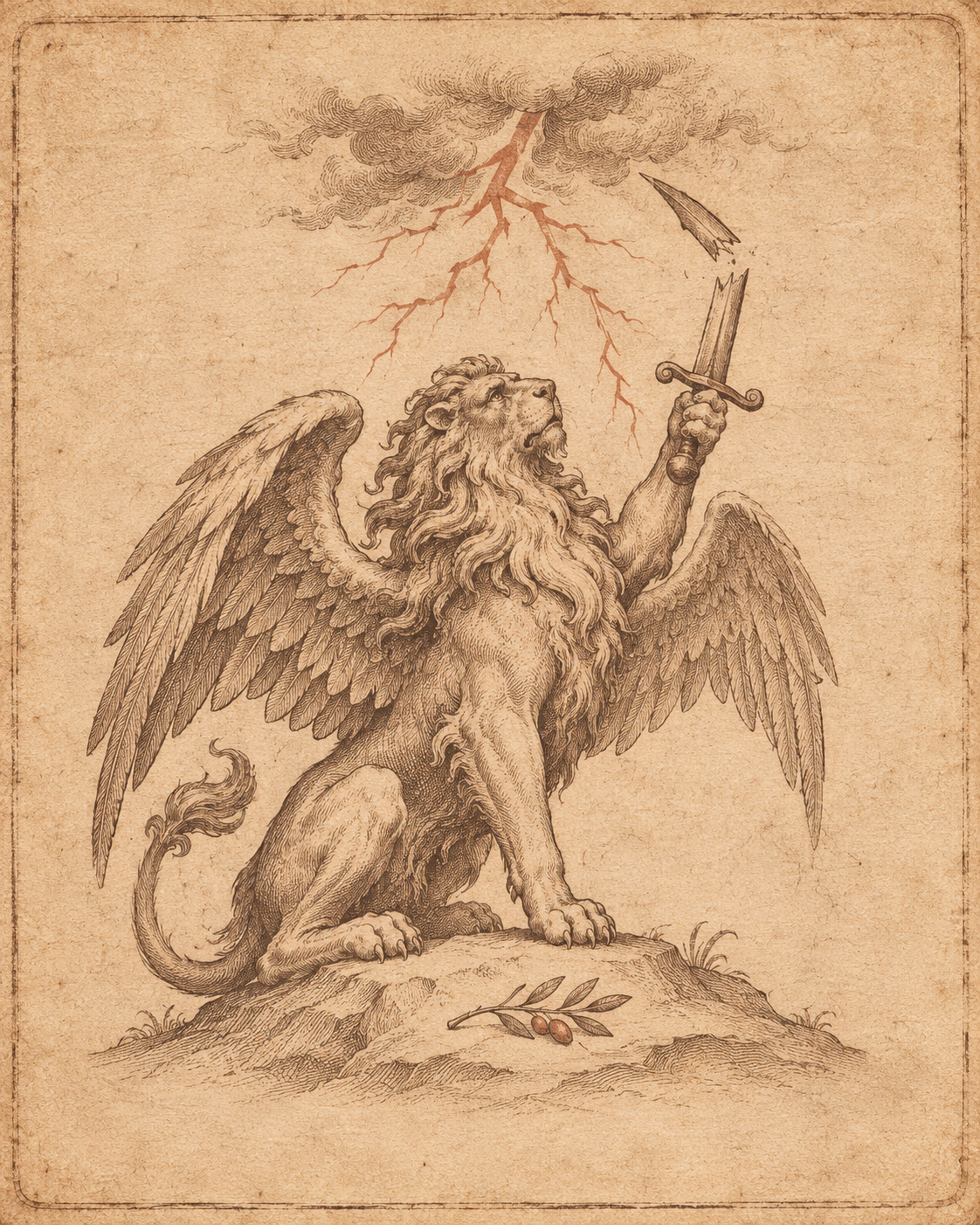
Dante’s moral landscape gives wrath a cloud of smoke, a fitting image for the way rage can obscure the next step. Medieval and Renaissance allegories also use weapons, fire, storms, and broken bodies to show how anger can turn its force outward. Our card uses lightning and a broken sword to suggest power that has not yet become wisdom.
The Wrath card: a lion beneath lightning
Our Wrath card shows a winged lion raising a broken sword while lightning splits the storm above. The lion gives anger a proud, protective body; the broken sword marks the point where force has outlasted its purpose. The image respects the power of a boundary while asking what happens when the weapon becomes the identity.
The counter-image is patience: not a smaller lion, but a lion that can lower the sword long enough to see what the storm is actually doing. Anger can remain strong while its next move becomes more deliberate.
Questions about the Wrath sin
Is anger always the wrath sin?
No. Anger can signal a boundary or injustice. The wrath sin describes anger that repeatedly escalates, seeks punishment, or remains in control after a proportionate response is no longer useful.
What is the opposite of the wrath sin?
Patience is the counter-virtue used here. It creates time between the signal of anger and the part of a response that cannot be taken back.
What symbol represents wrath?
Lightning, fire, weapons, storms, and a lion can represent wrath because they show speed, force, and danger. Our Wrath card uses a lion and a broken sword.
How does the wrath sin test work?
Five statements about frustration, replaying conflict, and reacting quickly are rated from 0 to 4. Wrath is one independent dimension among seven, not a safety or clinical assessment.
Can a high wrath score show a strength?
It can point to strong boundaries, fairness, and willingness to act. The next step is learning whether the response protects the boundary or adds harm that makes repair harder.
What should I do if a conflict is unsafe?
Prioritize distance, trusted support, and appropriate local safety resources. A quiz result should never replace a safety plan or professional help.
Sources and further reading
This guide combines the traditional seven-sins vocabulary with modern psychology research. It is written for reflection, not diagnosis.