
What Is the Sin of Lust?
Lust is traditionally understood as excessive or disordered sexual desire, especially when desire overrides respect, responsibility, or the dignity of another person. In everyday speech, lust can simply mean strong sexual desire. The Christian ethical question is how that desire is directed and how it shapes the way you treat others.Catechism of the Catholic Church, §2351
Attraction is a broader feeling of being drawn to someone. It can be physical, romantic, or emotional. A passing feeling of attraction can arise on its own. Respecting consent, keeping commitments, and caring about the other person are choices you make in response to that feeling.
Lust vs Love
In everyday relationship language, lust describes strong sexual desire. Love can include passion alongside care, intimacy, and commitment. In Robert Sternberg’s triangular theory, passion, intimacy, and commitment are distinct components that can occur together in a loving relationship.Sternberg (1986), A Triangular Theory of Love
Desire and love can coexist in a healthy intimate relationship. In a series of studies, Birnbaum and colleagues found that perceived partner responsiveness was associated with greater sexual desire. Feeling understood and valued can be part of what makes a partner desirable.Birnbaum et al. (2016), Partner Responsiveness and Sexual Desire
A survey by van Lankveld and colleagues also found that people who described their relationships as more intimate reported greater sexual desire. In that sample, the simple correlations between attachment-related needs and desire were weak.van Lankveld et al. (2021), Intimacy, Attachment, and Sexual Desire
| Dimension | Lust | Love |
|---|---|---|
| Core drive | Strong sexual attraction and desire | Care, intimacy, and commitment |
| Focus | Immediate attraction | The relationship and each other’s well-being |
| Timing | Can arise quickly | Often deepens over time |
| Can they coexist? | Yes, desire can be part of love | Yes, love can include desire |
How Our Test Defines Lust
In our Seven Deadly Sins Test, lust is interpreted more broadly as a tendency toward novelty, attraction, validation, and immediate gratification. The quiz uses these everyday patterns to ask how readily an exciting option, flattering message, or quick reward can pull you away from something you already value.
This is the definition we use for our quiz. Five self-report statements ask about everyday attention and impulse. Your score reflects your answers to those statements and is intended for personal reflection.
If lust is your top result
A high lust score suggests that novelty and recognition may change your mood quickly. You might be energized by a new conversation, a fresh idea, a flattering message, or the possibility of a different experience. This can make you curious, expressive, and open to connection. It can also make ordinary maintenance feel dull before its value has had time to appear.
The useful question is not whether you should stop wanting things. Ask whether you can enjoy attraction without making it your instruction. Can you stay with a plan after the first excitement fades? Can you hear another person’s boundary without reading it as rejection? These pauses protect desire from turning into entitlement or avoidance.
Signs of the Lust Pattern in Everyday Life
In the quiz’s broader sense, this pattern can appear as a quick change in attention. Look for the moments when a new stimulus becomes more compelling than a promise, a person, or a task you had already chosen. One enjoyable distraction is normal; the repeating handoff from one spark to the next is the pattern worth exploring.
- You lose interest as soon as an activity becomes familiar, even when it still matters to you.
- Flattery or online attention can steer your decisions more strongly than your stated priorities.
- You keep several possibilities open because choosing one would mean giving up the thrill of the others.
- A boundary or slower pace feels like a challenge to overcome instead of information to respect.
- You reach for a new purchase, message, image, or fantasy whenever a quiet moment brings discomfort.
- You confuse the intensity of a first impression with evidence that a connection or idea will last.
Is Lust Your Dominant Deadly Sin?
Discover whether your personality is driven by desire, novelty, or the need for attention—and see how your traits compare across all seven deadly sins.
Discover My Deadly SinWhat This Test Pattern Can Look Like
The useful side of a high score in this test dimension can look like curiosity, warmth, playfulness, and sensitivity to beauty. You may notice possibilities that other people miss and bring energy into a room that has become too routine. Desire can be a source of creative motion when it is paired with respect, patience, and the freedom for other people to choose their own pace.
The shadow arrives when intensity becomes the measure of truth. A stable relationship, long project, or quiet practice can seem worthless simply because it is not producing a constant rush. Chasing attention can also make another person feel like a mirror or reward rather than a whole person. Restraint does not remove desire; it gives desire a boundary in which trust can grow.
The Psychology of Novelty, Attention, and Impulse
Reward anticipation is the experience of expecting a payoff. In a monetary reward task, Knutson and colleagues found that activity in part of the ventral striatum increased as participants anticipated larger gains. In a separate choice task, Wittmann and colleagues found that participants showed a preference for novel options, with related activity in the striatum.Knutson et al. (2001), Reward AnticipationWittmann et al. (2008), Novelty-Based Choice
A learned reward can also pull attention away from the task at hand. Anderson and colleagues found that colors previously associated with rewards distracted participants during a later visual search task. Aron and Poldrack studied another part of impulse control by asking participants to stop an action they had already prepared.Anderson et al. (2011), Reward and AttentionAron and Poldrack (2006), Response Inhibition
These experiments study specific aspects of attention and choice. Our quiz invites you to reflect on more familiar situations. Before checking a message or switching to something new, ask what you expect to gain from it. You might be looking for reassurance, a break from boredom, or a chance to enjoy something new.
How the 7 Deadly Sins Test measures lust
In the 7 Deadly Sins Test, lust is one of seven independent dimensions. Five statements contribute to the lust score, and each answer is rated from 0 to 4 points. The 0-to-20 result is displayed as the raw score divided by 20, showing the share of possible points earned for this dimension rather than a population percentile. All seven dimensions use the same maximum score, so their results can be compared; the score does not measure sexual behavior, morality, or relationship quality.
The lust items focus on novelty, attention, anticipation, distraction, and the difficulty of staying with an ordinary pace. They intentionally avoid explicit content. Some statements are reverse-scored, and the final result is a prompt to notice patterns in everyday attention and impulse rather than a label that defines you.
How to Overcome Lust With Restraint
The counter-virtue for lust is restraint, sometimes described as temperance or chastity in older traditions. Restraint is not repression and it is not a demand to feel less. It means choosing how desire enters your schedule, body, communication, and commitments. The smallest useful practice is a pause that lets the first wave of excitement become one source of information rather than the whole decision.
- Before sending a high-intensity message, wait ten minutes and reread it with the other person’s autonomy in mind.
- Keep one ordinary promise after the first excitement of a new project has faded.
- When attention feels irresistible, name the need underneath it before reaching for another stimulus.
- Ask clearly for consent and accept a slower pace without turning it into a test of your worth.
Why lust is called a deadly sin
Lust is called a deadly or capital sin because it can give rise to other harmful choices. Thomas Aquinas explains that a capital vice draws people toward an appealing goal and can lead to further wrongdoing in pursuit of it. In the case of lust, the goal is sexual pleasure. That pursuit can, for example, lead someone to break a commitment or disregard another person’s boundaries.Thomas Aquinas, Summa Theologiae II–II, Question 153
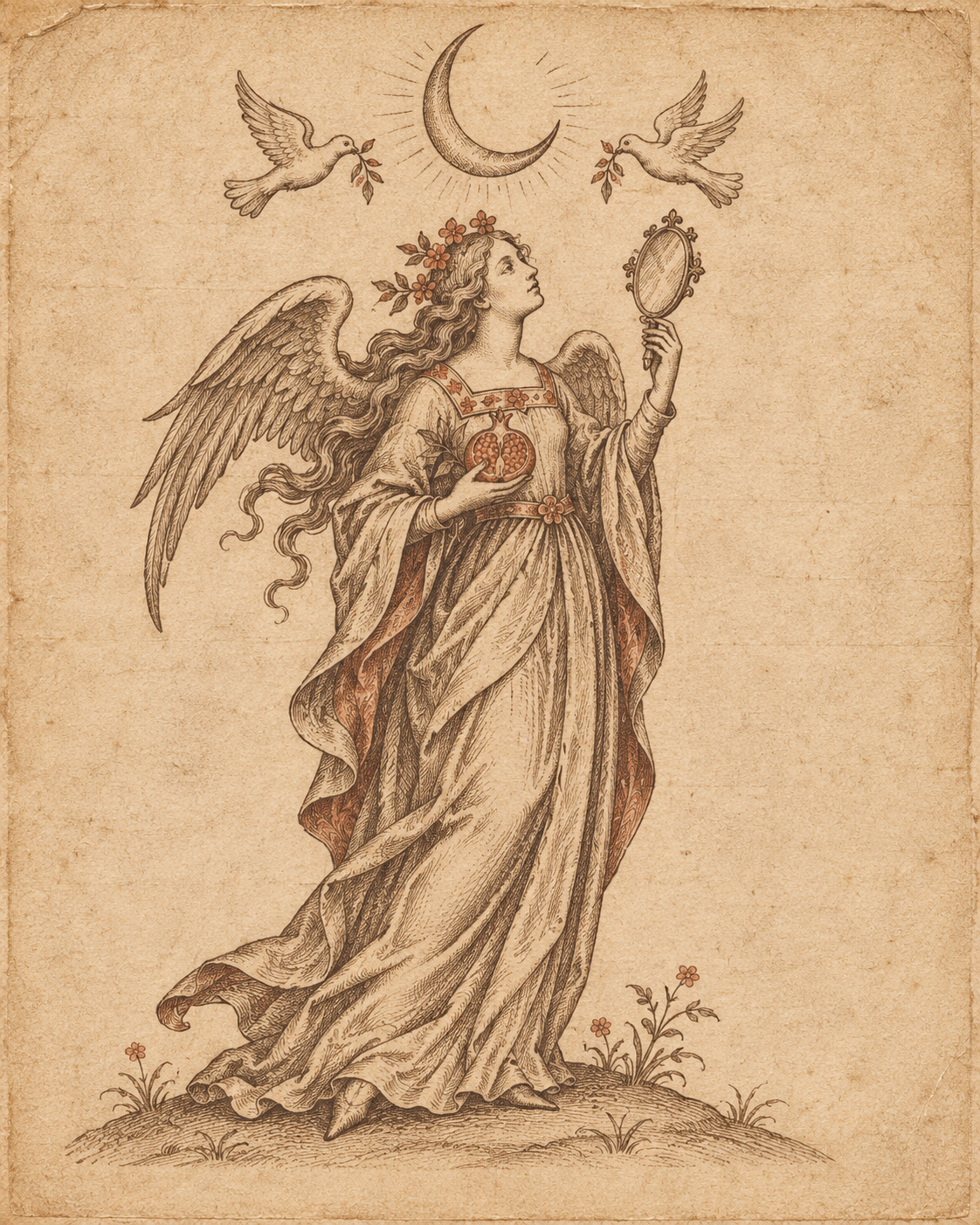
Medieval and Renaissance art often gives desire a mirror, flowers, music, or a figure pulled toward a beautiful scene. Dante’s moral architecture and Spenser’s allegorical figures turn an inward pull into a visible journey. These symbols give readers a way to picture how desire can shape a character’s choices.
The Lust card: a mirror beneath the moon
Our Lust card shows a winged figure holding a mirror and a pomegranate beneath a crescent moon, with birds carrying flowers overhead. The mirror captures the wish to be seen; the fruit suggests sweetness and invitation; the moon gives the scene a changing, temporary quality. The image is about the pull of attention, not explicit behavior.
The counter-image is restraint: the ability to let attraction remain alive without demanding an immediate answer. A desire can be real and still be delayed, questioned, redirected, or shared only when everyone involved can choose freely.
Questions about the Lust sin
Is lust a sin?
In traditional Christian ethics, lust is a sin when it refers to disordered sexual desire. Feeling attraction or sexual desire does not by itself establish that, and the ethical question concerns how desire is directed.
Can lust and love coexist?
Yes. In everyday relationship language, lust means strong sexual desire. It can coexist with love when attraction is accompanied by care, mutual respect, and regard for each other’s choices.
Does the lust sin test contain sexual questions?
No. This test frames lust as an everyday pull toward attention, novelty, validation, and immediate pleasure. It does not assess sexual identity, behavior, or relationship quality.
What is the opposite of the lust sin?
Restraint is the counter-virtue used here. It means giving desire a pause and a boundary so consent, values, and long-term care can guide the next choice.
What symbol represents lust?
A mirror, fruit, flowers, and moonlight are common visual symbols because they suggest attraction, beauty, changing attention, and the wish to be noticed. Our card combines those motifs.
How does the lust sin test work?
Five statements about novelty, attention, and impulse are rated from 0 to 4. Lust is one independent dimension among seven and is intended for self-reflection, not diagnosis.
Is enjoying attention the lust sin?
Enjoying attention and appreciation is an ordinary part of social life. Our quiz includes seeking validation as one everyday pattern to reflect on, especially when it repeatedly interrupts commitments or decisions you care about.
How can restraint help without making life dull?
Restraint protects choice. A short pause can help you enjoy attraction or novelty while still considering consent, consequences, and the people and projects you want to keep caring for.
What Would Your Seven Scores Look Like?
Take the free 35-question test to see your leading tendency and how you score across all seven traits.
Discover My Deadly SinSources and further reading
This guide combines the traditional seven-sins vocabulary with modern psychology research. It is written for reflection, not diagnosis.