
What Is the Sin of Sloth?
In traditional Christian ethics, sloth is associated with spiritual apathy, indifference, and neglect of meaningful responsibilities. Its older concept of acedia is more complex than the everyday label “lazy.” Rest, illness, disability, care responsibilities, or low energy alone do not establish a sloth pattern.
For this test, sloth is an operational reflection dimension about procrastination, avoidance, and difficulty beginning a chosen task. That modern interpretation helps people consider everyday behavior; it does not replace the historical religious meaning or diagnose depression, burnout, ADHD, poverty, or anyone’s worth.
What Is Acedia? The Original Meaning of Sloth
Acedia appears in early Christian monastic writing as one of the troubling thoughts that could pull a monk away from prayer, work, and communal responsibility. Evagrius Ponticus discusses it among eight thoughts; John Cassian later describes its restlessness and weariness in the monastic setting, including the image of a “noonday demon.”Evagrius Ponticus, The Eight Spirits of WickednessJohn Cassian, Institutes, Book X
Acedia is a historical religious concept, not an ancient medical name for depression. Scholars have compared the concepts while also noting that they are not interchangeable. Modern mental-health conditions should be understood through current clinical knowledge, not inferred from a medieval moral category.Crislip (2005), The Sin of Sloth or the Illness of the Demons?
If sloth is your top result
A high sloth score suggests that starting may feel harder than the task itself. You may wait for motivation, organize the conditions, or choose a smaller and easier task while the meaningful one remains on the list. This can happen even when you care deeply. The distance is often made of uncertainty, perfectionism, fatigue, resentment, or fear of discovering that the result will not match the hope.
A result like this does not define your character. It points to a moment where the system needs less friction or more support. The next step may be five minutes, a clearer question, an accountability partner, a rest period, or professional help. Diligence is not endless output; it is a reliable return to what matters at a sustainable pace. Seeing someone else move ahead may also bring up comparison, but that reaction is different from delaying your own task.Envy sin
Signs of the sloth sin in everyday life
Distinguish low activation from real depletion. If sleep, food, safety, access, or health is missing, the answer is support and recovery rather than self-criticism. If capacity is available but avoidance repeatedly takes the place of a chosen responsibility, that pattern may be useful to explore. If you call yourself lazy, consider whether confusion, fear, exhaustion, or missing support is a more accurate description.
- A task that would take ten minutes stays on your list because starting feels emotionally larger than finishing.
- You research tools, systems, or perfect conditions instead of taking the smallest visible action.
- You wait for the right mood and treat an ordinary low-energy day as proof that you cannot begin.
- You choose easy tasks to feel productive while avoiding the one task that would actually change the situation.
- You let a missed start become an excuse to abandon the whole plan rather than restart at a smaller scale.
Sloth vs. Laziness vs. Procrastination
Procrastination is a behavior, laziness is an informal judgment, and sloth is a traditional moral concept. They may overlap in everyday conversation, but they are not interchangeable. A student who has not started an assignment might be avoiding fear of failure, unsure how to begin, exhausted, or missing needed support; the delay alone cannot tell you why.
| Dimension | Sloth | Laziness | Procrastination |
|---|---|---|---|
| Core meaning | Traditional neglect or withdrawal from meaningful responsibilities | Informal label for unwillingness to exert effort | Delaying an intended action |
| Context | Religious and moral tradition | Everyday judgment, not a diagnosis | Behavior studied in psychology |
| Main focus | Apathy or disengagement from what matters | Avoiding effort; the reason varies | A gap between intention and action |
| Possible example | Repeatedly neglecting a valued commitment | Choosing not to do an optional task | Putting off an important assignment despite intending to start |
| Does the label diagnose a condition? | No | No | No |
Is Sloth the Same as Depression?
No. Sloth is a historical moral and religious concept; depression is a mental-health condition that can affect energy, motivation, concentration, and daily functioning. Difficulty starting a task does not establish that someone is lazy or morally at fault. Burnout, ADHD, disability, sleep problems, and other circumstances can also affect action, and none should be reduced to a moral label.National Institute of Mental Health, Depression
This section is for concept clarification, not diagnosis. If low mood, loss of interest, or difficulty functioning persists or causes distress, consider speaking with a qualified health professional.
The strength and shadow of sloth
The useful side of a sloth pattern is sensitivity to pace. You may know when a schedule is unsustainable, resist performative busyness, and value quiet, reflection, and recovery. Those are not weaknesses. A culture that treats constant output as virtue needs people who can notice when rest is a form of care rather than a failure to hustle.
The shadow appears when rest becomes a permanent waiting room. Avoidance can feel peaceful for an hour and expensive for a month. Unfinished tasks then create more dread, which makes the next start harder. The practical distinction is whether the pause is restoring a chosen capacity or protecting you from a next step that needs to be made smaller, clearer, or shared.
Sloth in psychology: motivation, friction and avoidance
Psychology research can explain procrastination and motivation, but it does not define sloth as a diagnosis. Research on self-regulation, short-term mood, and goal motivation offers distinct ways to understand why a person may delay or struggle to begin.
Procrastination and Self-Regulation
Steel’s meta-analytic review examined 691 correlations and identified task aversiveness, delay, self-efficacy, and impulsiveness among consistent predictors of procrastination. That research concerns procrastination as behavior; it does not establish that someone is lazy or morally at fault.Steel (2007), The Nature of Procrastination
Procrastination as Short-Term Mood Regulation
Sirois and Pychyl describe procrastination as sometimes prioritizing short-term mood repair: avoiding an unpleasant task can briefly ease discomfort, while leaving the future self with the task and its consequences. A small first action can reduce the emotional barrier without requiring the whole task to feel easy.Sirois & Pychyl (2013), Procrastination and Short-Term Mood Regulation
Motivation and Self-Determination
Self-determination theory distinguishes different forms of motivation and emphasizes autonomy, competence, and relatedness. When a task feels chosen, manageable, and supported, motivation may differ from a task approached only through pressure. This is one lens on goal pursuit, not a test of someone’s character.Deci & Ryan (2000), The “What” and “Why” of Goal Pursuits
How the 7 Deadly Sins Test measures sloth
In the 7 Deadly Sins Test, sloth is one of seven independent dimensions. Five statements about delay, starting, and choosing the easier route are rated from 0 to 4 points. The displayed percentage is the raw score divided by 20, showing the share of possible points earned for this dimension rather than a population percentile. All seven dimensions use the same maximum score, so their results can be compared; this is not a measure of productivity, health, disability, or moral worth.
The sloth items focus on the gap between intention and action, not on how many hours you work. Some statements are reverse-scored. Read the result alongside your actual conditions: sleep, stress, care responsibilities, access, mental health, and the kind of task you were trying to begin all matter.
How to Overcome Sloth with Diligence
The counter-virtue for sloth is diligence. Diligence is steady attention to a meaningful responsibility, not constant acceleration. It grows through small starts, visible progress, humane pacing, and a willingness to ask for help. The best first step is often so small that it feels almost too easy to count.
The 5-Minute Start Method
Use this as a practical task-starting exercise, not as a clinically validated treatment. The aim is to begin one meaningful task and decide what comes next after five minutes.
- Choose one delayed task, define the first physical action, and set a five-minute timer instead of planning the whole project.
- Put a stopping point on the calendar so rest is planned rather than used as an accidental escape.
- Tell one trusted person what you will start and when you will send a tiny proof of progress.
- If exhaustion, hopelessness, or executive-function problems keep blocking daily life, seek professional support rather than adding shame.
Why sloth is called a deadly sin
The older category of sloth was often closer to acedia: a resistance to the work, care, or attention that gives a life direction. It was not simply a complaint about being slow. The moral concern was that indifference could make a person withdraw from responsibility and community until the good they once valued felt unreachable.
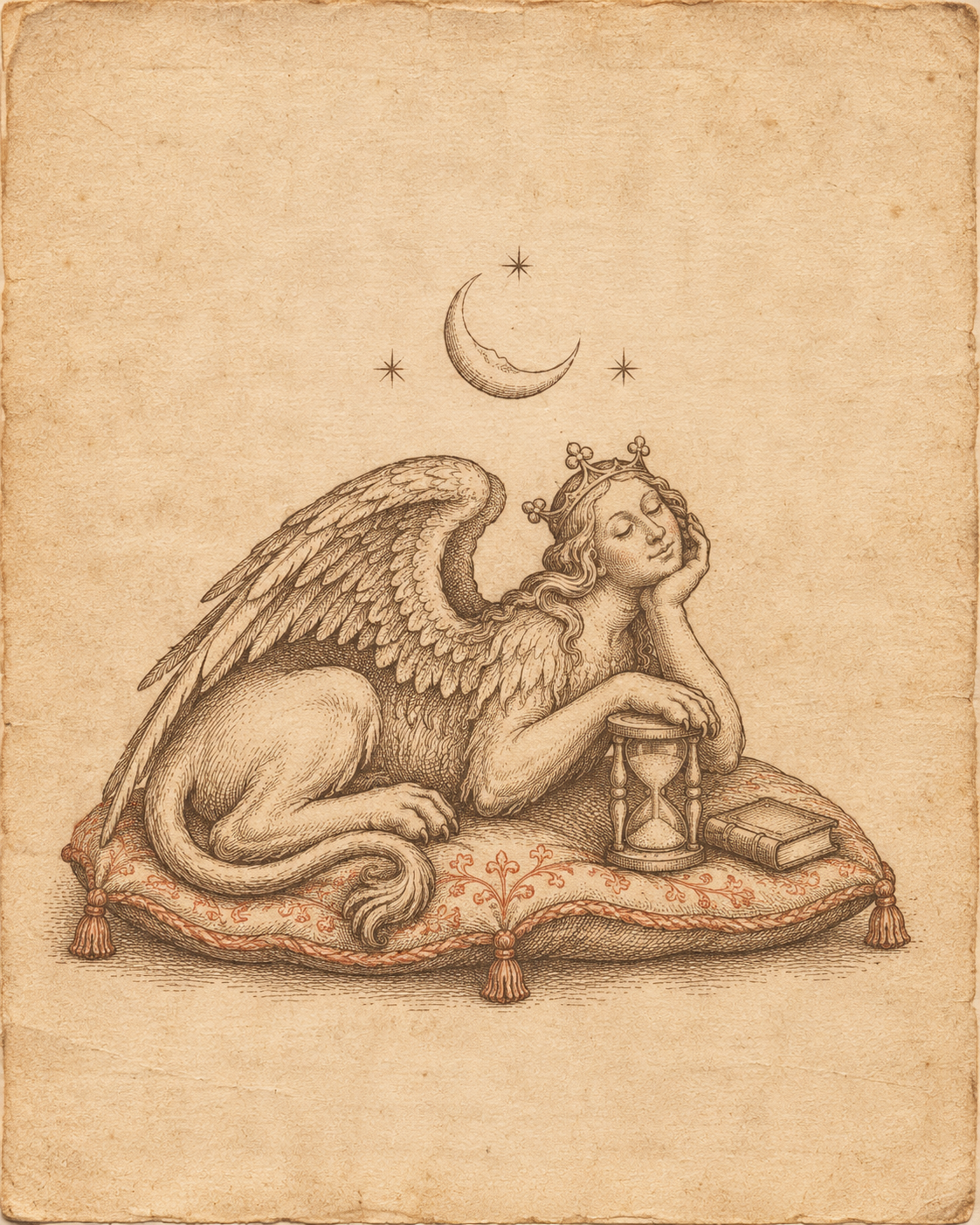
Dante places the slothful among those who must run with urgency in Purgatory, an image of movement returning to a person who had stopped moving toward the good. Later allegories use sleep, clocks, dusty books, and abandoned roads. Our card keeps the tenderness of rest while showing the hourglass that asks whether the pause still has a purpose.
The Sloth card: sleep beside an hourglass
Our Sloth card shows a sleeping winged figure resting on a patterned cushion beside an hourglass and a closed book. The scene is gentle rather than grotesque. Sleep can be necessary and beautiful; the hourglass asks how long the pause has lasted, and the book suggests a meaningful page that is still waiting to be opened.
The counter-image is diligence: not waking up to a life of pressure, but waking enough to take the next honest step. A person can rest without apologizing and still return to a promise when the time is right.
Frequently Asked Questions About Sloth
Is needing rest the sloth sin?
No. Rest, recovery, disability, illness, and care responsibilities are real needs. The sloth sin describes repeated avoidance of meaningful action, not a person’s worth or energy level.
What is the opposite of the sloth sin?
Diligence is the counter-virtue used here. It means returning to a meaningful responsibility with steady, humane effort rather than constant output.
What symbol represents sloth?
Sleep, an hourglass, a closed book, and an untraveled road can represent sloth because they show time, potential, and delayed movement. Our card uses a sleeping figure and hourglass.
How does the sloth sin test work?
Five statements about starting, delay, and choosing the easier route are rated from 0 to 4. Sloth is one independent dimension among seven and is not a productivity or health diagnosis.
Can a high sloth score point to something besides laziness?
Yes. Confusion, perfectionism, burnout, depression, inattention, fear, or a lack of support can all make starting harder. The score is a prompt to investigate the friction, not a final label.
What is a gentle first step toward diligence?
Make the first physical action smaller, set a five-minute timer, and stop or continue deliberately when it ends. If daily functioning remains difficult, seek appropriate support.
Sources and further reading
This guide combines the traditional seven-sins vocabulary with modern psychology research. It is written for reflection, not diagnosis.