
What Is the Sin of Gluttony?
The Latin name gula refers to appetite. In traditional Christian teaching, gluttony concerns excess in eating or drinking and the disorder that can arise when appetite outweighs moderation or one’s obligations to others.Seven deadly sins overview, Saint John's University archive
This guide keeps that traditional meaning distinct from the test’s broader use of gluttony as a reflection pattern around consumption and stopping. The extended meaning can help people consider digital or commercial habits, but it does not make those behaviors equivalent to the historical religious definition.
If gluttony is your top result
A high gluttony score suggests that consumption may be a reliable way to soften boredom, tiredness, loneliness, or an uncomfortable mood. You may be good at finding small pleasures and creating abundance for other people. The harder moment can arrive when the pleasure has changed into background noise but stopping would mean noticing what was underneath it.
A result like this is not a command to restrict yourself. It is a prompt to make the stopping point visible before you begin. You can enjoy the meal, episode, purchase, or scroll and still decide what enough looks like. The goal is a wider menu of responses, not a life without pleasure.
Signs of the gluttony sin in everyday life
Notice what happens at the transition between satisfaction and autopilot. A single indulgent day is not a moral pattern. Repeatedly using consumption to delay sleep, feelings, or decisions may be a more useful signal to explore with kindness and practical support.
- You keep eating, watching, scrolling, or buying after you can tell the original enjoyment has flattened.
- You begin a treat or a feed without deciding how much time, money, or attention you want to give it.
- You reach for consumption first whenever a quiet moment exposes boredom, fatigue, or sadness.
- You feel restless when there is nothing to sample, stream, refresh, or plan next.
- You hide the amount or duration of a habit because explaining it would make the pattern feel real.
- You treat stopping as deprivation even when continuing no longer feels especially good.
- You repeatedly choose another episode, purchase, or indulgence when it interferes with sleep, relationships, or responsibilities.
Is Gluttony Your Dominant Deadly Sin?
Discover how your consumption habits compare with the other six deadly sin traits.
Discover My Deadly SinGluttony vs. Greed: What’s the Difference?
Gluttony focuses on excessive consumption; greed focuses on excessive acquisition or possession. The two can overlap, but wanting to enjoy something is different from wanting to own or keep more of it.Greed sin
| Dimension | Gluttony | Greed |
|---|---|---|
| Core desire | Consuming more | Accumulating or keeping more |
| Main focus | Enjoyment or consumption | Ownership or possession |
| Traditional examples | Excessive eating or drinking | Excessive desire for wealth or possessions |
| Modern reflection | Repeated entertainment or other consumption | Pursuing more money, resources, or status |
| Question to reflect on | How much more can I consume? | How much more can I have? |
| Counter-virtue | Temperance | Generosity |
The strength and shadow of gluttony
The useful side of a strong gluttony pattern is appreciation. You may know how to savor a meal, make a gathering feel generous, and notice sensory details that other people rush past. Pleasure can be restorative, and shared abundance can build community. Temperance is not a rejection of enjoyment; it is what helps enjoyment remain connected to the body and the moment.
The shadow appears when more stimulation becomes the default answer to every state. A full table, endless feed, or constant queue can make a quiet life feel like a problem. Overconsumption can also borrow from tomorrow’s sleep, money, health, or attention. The practical question is whether the next input is adding nourishment or only postponing a need that deserves a different response.
Gluttony in psychology: reward loops and autopilot
Psychology offers useful ways to understand some consumption patterns, including pleasure-driven appetite and habits cued by familiar contexts. These mechanisms can help explain why a person continues an activity, but they are not definitions of the traditional sin, and they do not mean that ordinary enjoyment is a disorder.
Hedonic Hunger vs. Physical Hunger
Physical hunger is associated with the body’s need for energy. Hedonic hunger describes wanting palatable food for pleasure, including when energy needs may not be the immediate driver. Lowe and Butryn discuss this as a dimension of appetite; it is a normal experience and, by itself, does not indicate a problem with eating or self-control.Lowe & Butryn (2007), Hedonic Hunger: A New Dimension of Appetite?
| Dimension | Physical Hunger | Hedonic Hunger |
|---|---|---|
| Main driver | Physiological energy needs | Desire for pleasurable food |
| Typical cues | Time since eating and bodily signals | Food cues, taste, or anticipation |
| What it describes | Appetite related to nourishment | Reward-related wanting |
Habit Loops and Reward Cues
Habits can form when a response is repeated in a recurring context. A familiar cue may prompt an action with little deliberation, even when the reward has become less satisfying. Wood and Rünger’s review describes habits as context-linked responses that can guide behavior alongside deliberate goals.Wood & Rünger (2016), Psychology of Habit
A practical way to add choice is to notice the cue and adjust the routine around it: move an app off the home screen, decide on a stopping point before pressing play, or pause to ask what you want from the next action. These are experiments in awareness, not rules for restricting food. When entertainment repeatedly displaces obligations, that avoidance can overlap with a different reflection theme.Sloth sin
How the 7 Deadly Sins Test measures gluttony
In the 7 Deadly Sins Test, gluttony is one of seven independent dimensions. Five statements contribute to the gluttony score, with answers rated from 0 to 4 points. The score is shown as the raw score divided by 20, representing the share of possible points earned for this dimension rather than a population percentile. All seven dimensions use the same maximum score, so their results can be compared; this does not evaluate diet, body size, medical risk, or eating-disorder symptoms.
The gluttony items focus on continuing past enough, using consumption to change a mood, and difficulty creating a stopping point. Some statements are reverse-scored. The quiz is meant to open a gentle conversation with yourself, not to replace a clinician, a nutrition professional, or your own understanding of your body.
How to Overcome Gluttony with Temperance
The traditional counter-virtue for gluttony is temperance. Temperance means proportion and awareness, not punishment. It lets pleasure be fully pleasurable while making room for rest, hunger, boredom, and other signals that consumption can temporarily cover. Choose experiments that increase choice rather than create fear around food or ordinary enjoyment.
Mindful Consumption: Recognizing When Enough Is Enough
Mindful consumption means noticing what you are choosing, what you are feeling, and whether you want to continue. It is not a demand to eat less or to treat pleasure as a failure. For digital or shopping habits, a planned pause or a clear stopping point can help make the next choice deliberate.
- Before starting a treat, episode, or shopping session, choose a stopping point and make it easy to see.
- Add one non-consumption response to your comfort menu, such as a walk, a call, music, or ten quiet minutes.
- Put a small pause between the cue and the next input so your decision is not made entirely on autopilot.
- When the pattern feels distressing or affects your health, ask a qualified professional for support instead of relying on shame.
Why gluttony is called a deadly sin
The older tradition called gluttony a capital sin because appetite could become a form of disorder: a person might value the pleasure of consumption above hospitality, health, duty, or another person’s need. These categories were shaped by historical religious contexts and should not be used to moralize bodies or food. Their lasting question is about proportion and attention.
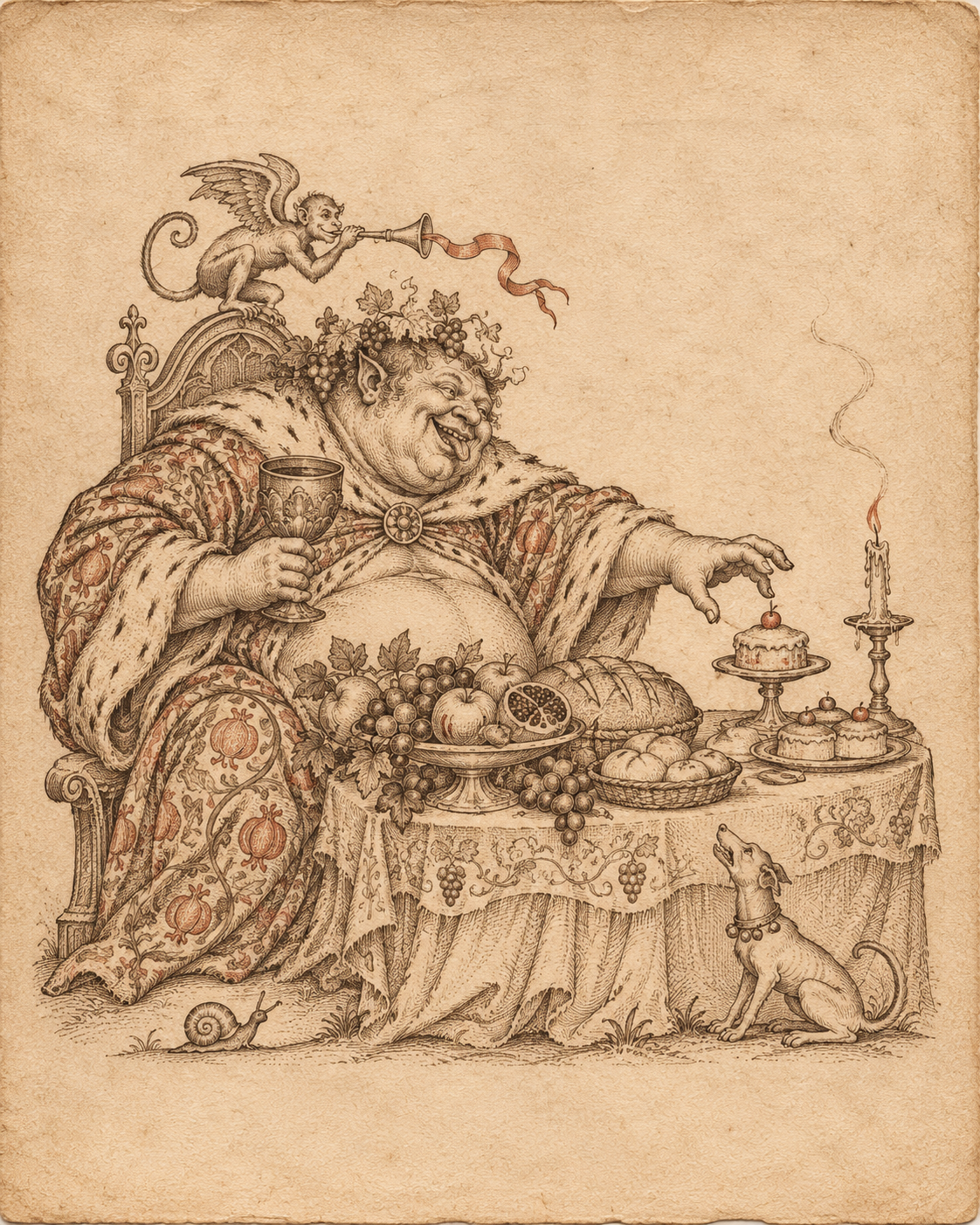
Artists often represented gluttony with a feast, a cup, a swollen figure, or a table that cannot be cleared. Dante and later allegorical writers use excessive eating as an image for appetite without a horizon. Our modern application adds digital and commercial consumption, where the table may be a glowing screen and the next course may arrive with one tap.
The Gluttony card: a feast that keeps arriving
Our Gluttony card shows a richly dressed figure seated before fruit, bread, pastries, a cup, and a table that is already full. A tiny herald blows a horn above the scene, as if announcing that another course is coming. The image is intentionally theatrical: the problem is not that the feast exists, but that the feast has no clear ending.
The counter-image is temperance. It lets a person receive pleasure, pause before the next plate, and notice the difference between being nourished and being distracted. Enough is not a punishment; it is a moment that can be felt.
Frequently Asked Questions About Gluttony
What is the sin of gluttony?
Gluttony is traditionally understood as excessive or disordered consumption of food and drink, especially when appetite outweighs moderation and responsibility. This test also uses the term as a broader reflection prompt about overconsumption.
Why is gluttony one of the seven deadly sins?
In Christian moral tradition, gluttony is a capital vice because appetite can take priority over moderation, hospitality, or responsibilities to others. The historical idea should not be used to shame bodies or ordinary enjoyment.
Is gluttony only about food?
Food and drink are the traditional focus. This website extends the idea for self-reflection to other forms of consumption, such as entertainment or shopping, while recognizing that these are not identical to the historical religious meaning.
What are examples of gluttony?
Traditional examples center on excessive eating or drinking. In this test’s broader reflection framing, examples can include continuing to stream, scroll, or shop after the activity has stopped feeling satisfying.
What is the difference between gluttony and greed?
Gluttony centers on excessive consumption, traditionally of food and drink. Greed centers on excessive acquisition or possession, such as wealth or goods. They can overlap but describe different patterns.
Is overeating always gluttony?
No. Eating more than usual does not automatically indicate gluttony. Appetite and eating behavior can be influenced by physical, emotional, social, and environmental factors; one episode is not a moral judgment.
How can I overcome gluttony?
Practice temperance as awareness and choice, not punishment. You might set a stopping point for a digital activity or add a pause before continuing. Avoid extreme restriction or shame around food; seek qualified support if eating feels distressing or unsafe.
What does a high gluttony score mean?
It means your answers showed more of the consumption patterns this quiz groups under gluttony, such as difficulty stopping or using an input to shift a mood. It is a reflection prompt, not a diagnosis or assessment of your diet or body.
Which of the Seven Deadly Sins Defines You Most?
Take our free 35-question personality test to explore all seven traits and see whether gluttony is your leading tendency.
Take the Free TestSources and further reading
This guide combines the traditional seven-sins vocabulary with modern psychology research. It is written for reflection, not diagnosis.