
What Is the Sin of Pride?
In traditional Christian ethics, pride, or superbia, is an exaggerated sense of your own importance. It can show up as a belief that you deserve more credit, know better than everyone else, or should be exempt from correction. That attitude can make it harder to acknowledge mistakes, accept help, and recognize what other people contribute.
Everyday pride can also be the satisfaction you feel after doing something well. The traditional concern is the need to stand above others. A useful question is whether you can take pride in your work and still share credit, listen to feedback, and change your mind.
Why Is Pride One of the Seven Deadly Sins?
The word deadly refers to the older idea of a capital or head sin: a habit that can give rise to other harmful habits. Gregory the Great placed pride above the other sins and connected it with boasting, hypocrisy, quarrels, stubbornness, and discord. The point is not that every confident person will behave this way. The point is that a need to stay above others can quietly change how a person handles correction, responsibility, and community.
The same need to protect your standing can show up in different ways. A colleague’s success may trigger envy, and a public correction may trigger wrath. These patterns can overlap in a single situation.Envy sinWrath sin
7 Signs of Pride in Everyday Life
Pride often shows up in small reactions at work, at home, and with friends. Look for patterns across situations. A single behavior can have several explanations, and these examples are prompts for reflection.
- When a mistake comes up, you explain why someone else caused it before acknowledging your part.
- You assume a less experienced person has nothing to teach you.
- You feel overlooked if people praise the whole team without singling out your contribution.
- You push back on criticism before checking whether any of it is useful.
- You add a justification to an apology before the other person has a chance to respond.
- You use other people’s achievements to rank your own worth.
- You dismiss a different opinion before hearing the reasoning behind it.
Do These Signs Sound Familiar?
Discover how pride compares with your other six deadly sin traits.
Discover My Deadly SinPride vs. Confidence: What’s the Difference?
Healthy confidence starts with a realistic view of what you can do. It leaves room for feedback, other people’s strengths, and the possibility that you missed something. Sinful pride depends more on feeling superior. Arrogance is one way it can come across to other people, especially when their ideas or abilities are dismissed.
Think of a recent success. Could you enjoy the achievement, acknowledge what helped you get there, and hear what could have gone better? Our quiz asks about similar reactions to recognition, mistakes, and help.Seven Deadly Sins personality test
| Dimension | Healthy Confidence | Sinful Pride |
|---|---|---|
| Self-worth | Based on realistic self-awareness | Depends on feeling superior |
| Response to criticism | Considers feedback | Gets defensive or dismissive |
| View of others | Respects other people’s strengths | Looks down on others |
| Mistakes | Willing to admit errors | Struggles to take responsibility |
| Success | Enjoys the achievement | Seeks repeated recognition |
| Relationships | Encourages mutual respect | Can create competition or distance |
Pride in Psychology
In psychology, Jessica Tracy and Richard Robins distinguish between authentic pride, associated with achievement and effort, and hubristic pride, associated with arrogance and inflated views of the self. You might recognize authentic pride in feeling good about a skill you worked hard to develop. Hubristic pride might show up as treating the same achievement as proof that you are better than others.Tracy and Robins (2007), The Psychological Structure of Pride
The distinction gives readers a way to compare everyday feelings with the older ethical idea. Satisfaction can coexist with humility. When your sense of worth depends on being above correction, ordinary feedback can start to feel like a personal threat.
The Strengths and Shadows of Pride
A pride pattern is not an instruction to make yourself smaller. Its useful side can look like ownership, high standards, courage under pressure, and the willingness to take responsibility when a group needs direction. People with a strong pride score may be good at starting difficult work, defending quality, and noticing when a project is drifting.
The shadow appears when achievement becomes the only acceptable proof of worth. Feedback starts to sound like an insult, delegation feels like surrender, and another person’s success feels like a threat. The practical question is not “How do I remove ambition?” It is “Can I keep my standards while letting other people contribute, lead, and be right sometimes?”
How to Overcome Pride with Humility
The traditional remedy for pride is humility. Humility is not pretending that you have no strengths. It is the ability to hold your strengths accurately: you can be capable without being the only capable person in the room, and you can be wrong without becoming worthless. Small experiments work better than a promise to become a completely different person.
- Ask one person for help this week with something you could technically do alone.
- Say “I was wrong about that” once without immediately explaining why your original idea made sense.
- Give someone credit in public before anyone asks you to share it.
- When you feel the urge to correct somebody, ask one curious question first.
What If Pride Is Your Dominant Sin?
A high pride score suggests that recognition, competence, and self-reliance may carry extra weight in your everyday decisions. You may trust your own judgment quickly and feel most comfortable when you can take responsibility for the outcome. You may also notice a sharper reaction when your work is overlooked, your judgment is questioned, or somebody else receives credit for an idea you helped shape.
That result contains both a strength and a useful warning. Pride can push you to prepare carefully, protect a standard, and finish what you start. The same drive can make collaboration feel like a loss of control. Instead of asking whether pride is simply good or bad, notice the moment when a wish to do something well turns into a need to be the person who is right.
How Our Seven Deadly Sins Test Measures Pride
In the 7 Deadly Sins Test, pride is one of seven independent dimensions. Five statements contribute to the pride score, and each answer is rated from 0 to 4 points. That gives the dimension a range from 0 to 20. The displayed percentage is the raw score divided by 20, so it shows the share of possible points earned for this dimension, not a population percentile. Because all seven dimensions use the same maximum score, their results can be compared without creating a single “good” or “bad” total.
The pride items focus on five everyday themes: confidence that your idea is best, discomfort with admitting mistakes, the wish to be noticed, reluctance to ask for help, and judgments about other people’s ability. Some items are reverse-scored so that agreement does not always point in the same direction. The quiz is designed to reveal a pattern you can think about, not to decide who you are.
Pride in Art, Literature and Symbolism
Dante places the proud on the first terrace of Purgatory, bent beneath heavy stones so they must finally look down. In Hieronymus Bosch’s depiction of the seven deadly sins, pride appears through a woman admiring herself in a mirror held by a demon. Edmund Spenser gives pride a queen, Lucifera, whose coach is drawn by the other six sins. These images all turn the same idea into a scene: the desire to be elevated can become a burden.
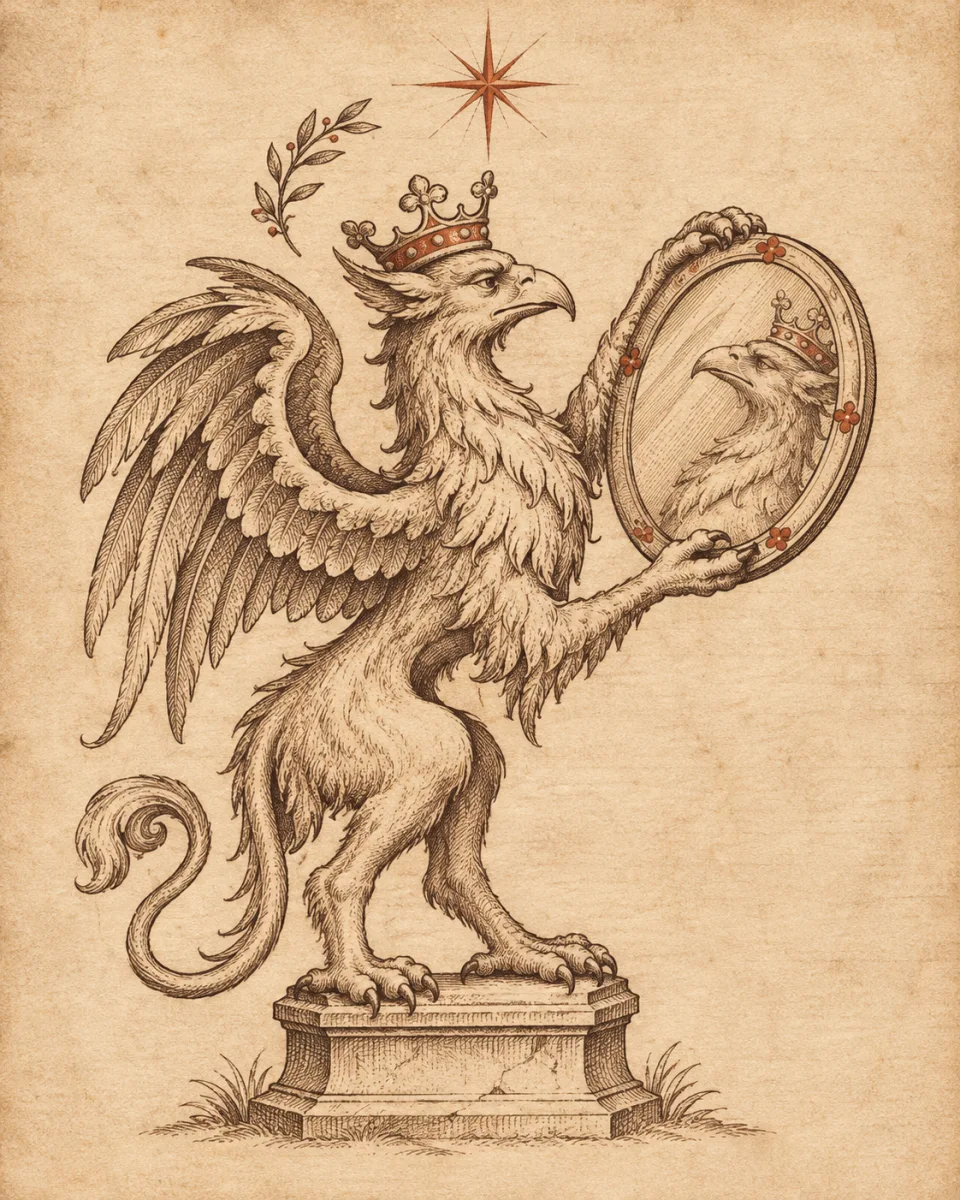
Our Pride card shows a crowned peacock standing on a small stone throne while holding a mirror. The peacock represents display and the pleasure of being noticed; the mirror represents the moment when self-knowledge turns into self-absorption. The image is intentionally theatrical, because pride is often not a lack of ability. It is the performance of being above ordinary limits.
The counter-image is humility: not a collapse, but a return to proportion. A person can enjoy the work, accept the crown for a moment, and still step down from the throne when another perspective is needed.
Frequently Asked Questions About Pride
What is the sin of pride?
In traditional Christian ethics, the sin of pride is an excessive sense of self-importance. It can make it harder to acknowledge limits, listen to correction, or give others the credit they deserve.
Why is pride considered a deadly sin?
Pride is considered a capital vice because the desire to feel superior can lead to other harmful choices, such as belittling a rival or hiding a mistake to protect your reputation.
Is pride always a sin?
Feeling satisfaction after effort or an achievement can be healthy. The traditional moral concern is pride that puts your status above honesty, responsibility, or respect for others.
What are examples of pride in everyday life?
Examples include taking credit for a team’s work, dismissing advice from someone younger, or justifying a mistake instead of making it right. Context and repeated behavior matter.
What is the difference between pride and confidence?
Healthy confidence lets you trust your abilities and still revise your judgment. Sinful pride ties your worth to feeling superior, which can make feedback or another person’s success feel threatening.
Is pride the worst of the seven deadly sins?
Some Christian writers place pride above the other vices because it can feed them. That ranking describes the influence of pride in a moral tradition. The quiz uses seven independent scores.
How can I overcome pride?
Practice humility in one specific situation. Ask for feedback, give someone credit by name, or admit an error in a short sentence before explaining how you will fix it.
What does a high pride score mean?
A high pride score means your answers showed more of the behaviors this quiz groups under pride, such as valuing recognition or struggling to admit a mistake. Use it to reflect on where those patterns help you and where they create friction.
Which of the Seven Deadly Sins Defines You Most?
Discover your dominant deadly sin and see how you score across all seven traits.
Take the 35-Question TestSources and further reading
This guide combines the traditional seven-sins vocabulary with modern psychology research. It is written for reflection, not diagnosis.